
What's the Difference Between Weekly, Biweekly and Semi-Monthly Pay?
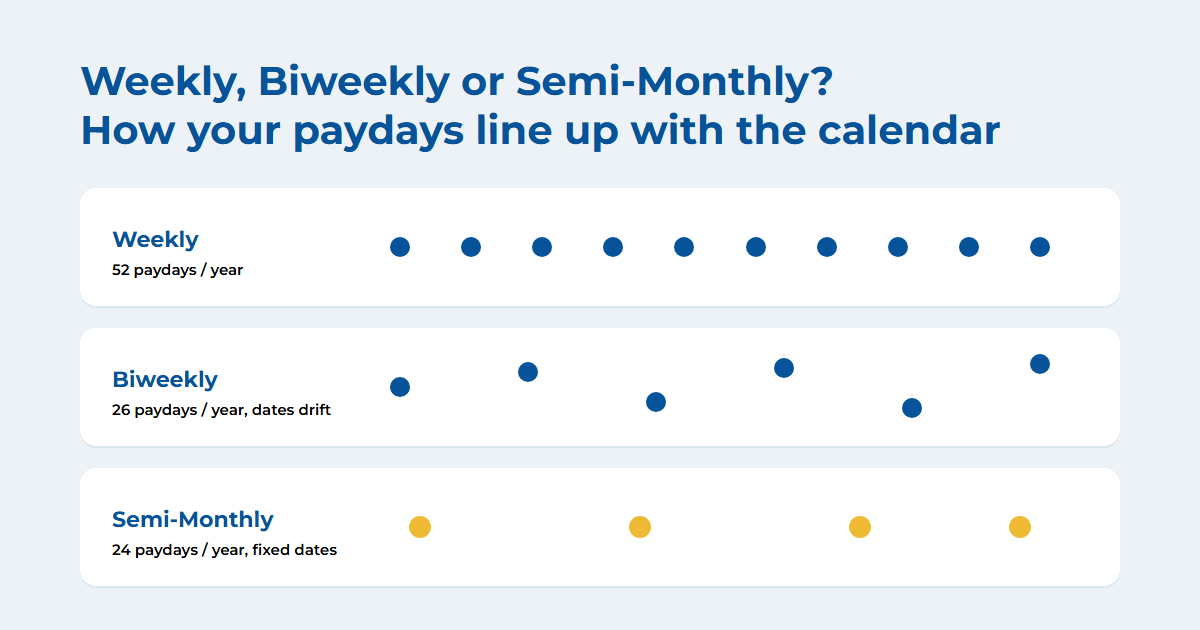
Weekly pay lands 52 times a year, biweekly pay lands 26 times, and semi-monthly pay lands exactly 24 times, always on the same two dates. That one-word difference between biweekly and semi-monthly changes how your paycheques line up with your bills, and most budgeting advice treats them as the same thing. They're not, and knowing which one you're on is the first step to building a budget that actually holds up.
Weekly Pay: 52 Paydays That Keep You Current
If you're paid weekly, money shows up every single week, on the same day. It's the easiest schedule to plan around because the gap between paydays never changes.
The tradeoff is smaller paycheques. A $1,000 monthly bill isn't one big hit, it's roughly $231 a week once you divide it across all 52 paydays. Weekly pay rewards people who set aside a bill's share from every single cheque rather than waiting for the one with rent in it, because there isn't one cheque that's supposed to cover it alone.
Most years bring exactly 52 weekly paydays, but not every year does. Since 365 days doesn't divide evenly by 7, one weekday lands 53 times instead of 52 in most calendar years. 2025 was an example: January 1st fell on a Wednesday, and Wednesday ended up occurring 53 times that year, so anyone paid weekly on a Wednesday saw a 53rd paycheque. It's not a bonus, it just means your yearly total needs the share from one extra payday built in.
Biweekly Pay: 26 Paydays That Drift
Biweekly pay means every two weeks, on a fixed day like every other Friday. That gives you 26 paycheques a year, not 24, and the date slowly drifts across the calendar. A payday on January 2nd creeps to January 16th, then the 30th, and by spring it's landed on a completely different day of the month than when you started.
That drift is why a budget built around this paycheque covers rent eventually breaks. The bill's due date doesn't move, but your payday does. Because 26 doesn't divide evenly into 12, biweekly pay also produces two months a year with three paycheques instead of two, which can look like a windfall but is really just the math catching up.
Set Up Your Budget Around Your Payday →
On rare occasions, biweekly pay can bring a 27th paycheque for the year, not just a third paycheque in one month. Twenty-six paydays, 14 days apart, add up to 364 days, one short of a full year. If your very first payday of the year lands on January 1st or 2nd, that extra day is sometimes enough room for one more payday to fit in before December 31st. For any one pay schedule, that tends to happen roughly once every 11 years, so it's uncommon, but it's not a glitch when it shows up.
Semi-Monthly Pay: 24 Paydays That Never Move
Semi-monthly pay looks similar to biweekly at a glance, but it's fixed to the calendar instead of the clock. You're paid twice a month, usually on set dates like the 1st and the 15th, which comes out to 24 paycheques a year. Because the dates are fixed, the gap between paydays isn't always equal. Paying out on the 1st and 15th means 14 days one stretch and 16 or 17 the next, depending on the month.
The upside is that a semi-monthly paycheque never drifts away from a bill due on a specific day. The catch is that two paycheques a month, not 26 a year, means each one needs to cover a slightly bigger slice of every monthly bill.
Why This Matters More Than the Budgeting Advice You'll Find
Most budgeting guides quietly assume you're paid once a month, and a lot of the rest blur biweekly and semi-monthly together because they both sound like twice a month. They aren't. Someone on biweekly pay is managing drift. Someone on semi-monthly pay is managing fixed dates with uneven gaps. The fix for one isn't automatically the fix for the other.
Say your rent is $1,800. On biweekly pay, you'd set aside $900 from each of 26 paycheques. On semi-monthly pay, you'd set aside $900 from each of 24 paycheques, same split, different number of paydays doing the work. Treating the two schedules as interchangeable is how budgets quietly come up short.
The one rule that holds across all three schedules: split every bill across every paycheque you actually receive, instead of pinning it to one payday. QUBER's My Budget does this automatically once you tell it your pay schedule, whether that's weekly, biweekly or semi-monthly, so you're not the one doing the division every cycle.
FAQ
Is biweekly the same as semi-monthly?
No. Biweekly is every two weeks (26 paydays a year, dates drift). Semi-monthly is twice a month on fixed dates (24 paydays a year, gaps between them vary).
Which pay schedule gets more paycheques a year?
Weekly, with 52. Biweekly comes next with 26, then semi-monthly with 24.
Does QUBER work the same way for all three schedules?
Yes. My Budget splits every bill across whichever paydays you actually get, so the approach holds whether you're paid weekly, biweekly or semi-monthly.
Can weekly or biweekly pay bring an extra paycheque in a year?
Yes. Weekly pay occasionally brings 53 paydays instead of 52, since one weekday lands 53 times in most calendar years, as Wednesdays did in 2025. Biweekly pay can bring 27 instead of 26, though that happens only about once every 11 years for a given pay schedule.
Knowing your exact pay schedule, not just I get paid twice a month, is what makes a budget hold up over time. Once you know which one you're on, you can build around it instead of around a guess.
Set Up Your Budget Around Your Payday →
Small steps add up, and your future self will thank you